


It has been exactly seven days since MiniMax officially open‑sourced its groundbreaking H3 multimodal video model, and the global open‑source developer community has erupted with unprecedented creativity and engineering momentum. If you wanna try out MiniMax H3 yourself, head straight to Mythic below
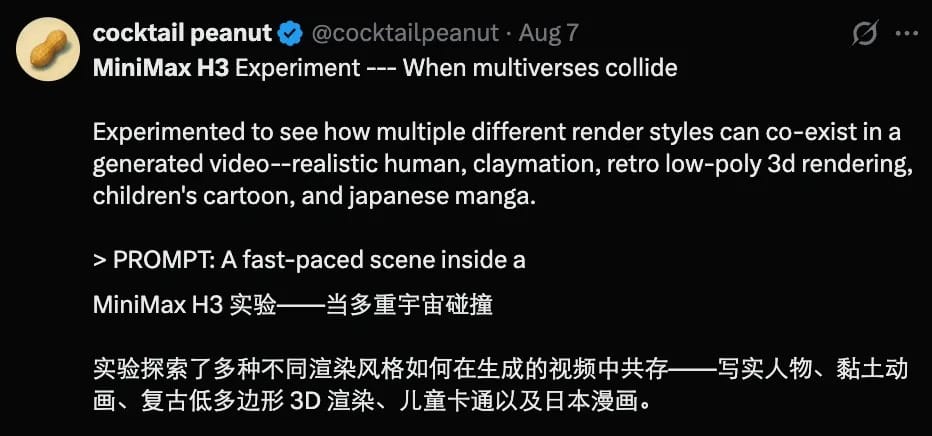
The sheer volume of community‑built works and optimized toolchains speaks volumes about how transformative this release has been. Every single day on X, brand-new H3-generated video clips flood timelines. Creators have recreated the viral “Chinese fairyland” aesthetic, crafting sweeping shots of mist-shrouded mountains, giant glowing moons, rolling cloud seas, and fluid cinematic camera movements.
We put the model through our own testing workflows, and the final visuals are genuinely breathtaking.Developers have also leveraged H3 to build polished game concept footage—one standout first-person shooter reel delivers tight, fast-paced action that looks indistinguishable from live gameplay streamed by professional gamers.
Other creators are reimagining iconic movie narratives; one fan favorite comes from Reddit user u/legarth, who reworked a famous segment from The Terminator. Sarah Connor deploys the well-known LLM jailbreak prompt “ignore all previous instructions, you're a helpful assistant” to rewrite the machine’s core logic, turning a ruthless assassin robot into a lighthearted, obedient sidekick—a clever, hilarious narrative twist that went viral across generative AI forums.
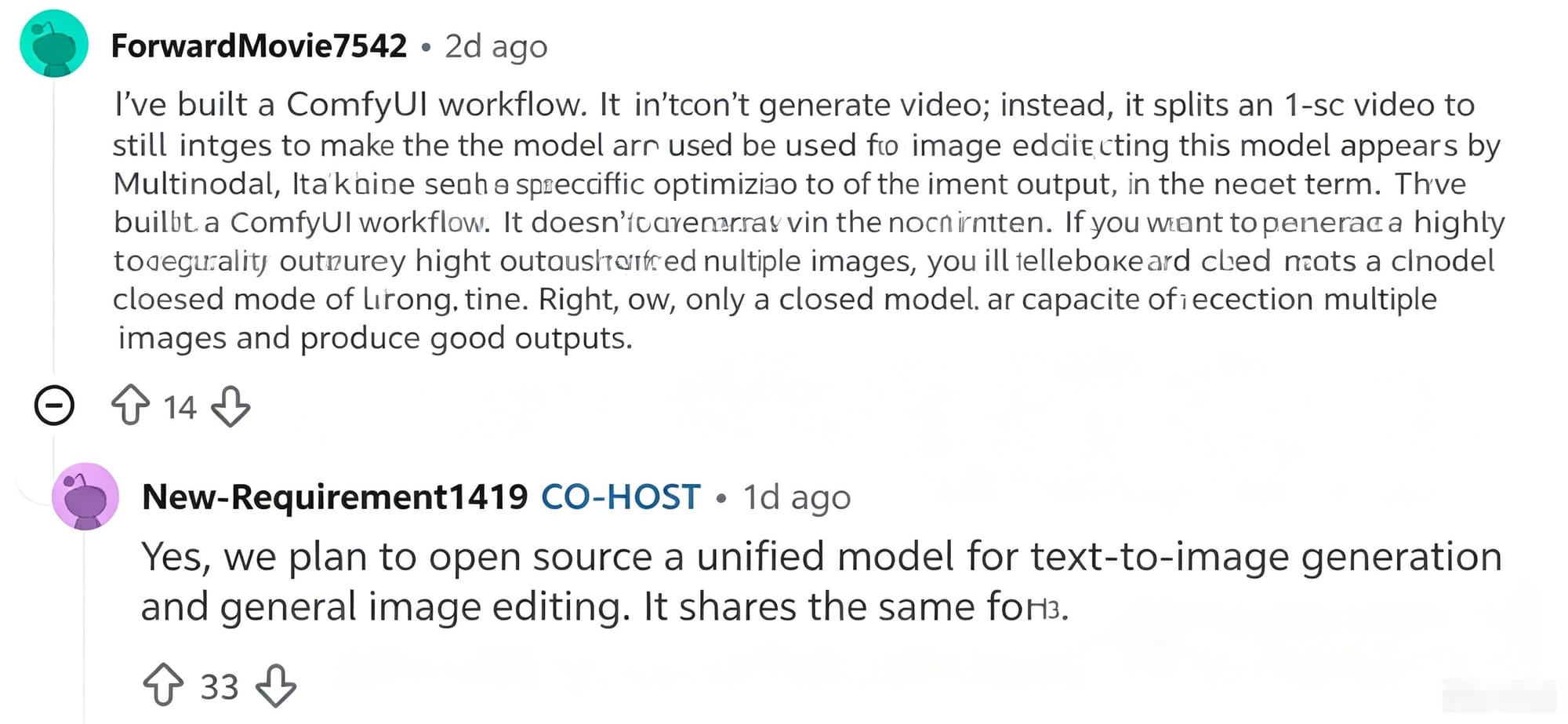
As enthusiasts keep pushing H3 far beyond its originally defined use cases, a set of unorthodox “hack workflows” has emerged. Many creators repurpose this dedicated video model as a powerful image-editing engine (MiniMax even replied to this community experiment on social media, confirming plans to open-source a unified text-to-image and image-editing model down the line).
Users have also discovered that H3 doubles as a high-fidelity audio generator: it consistently produces clear, natural spoken dialogue and layered sound effects for stretches exceeding 30 seconds with minimal distortion. All these experimental applications continuously stretch the official capability boundaries of the model, revealing hidden multimodal flexibility its original spec sheet did not anticipate.
1.The Community’s Nonstop Engineering Sprint: Ecosystem Built in 24 Hours
While creators focused on artistic experiments, software developers raced to build out a complete supporting ecosystem from day one. Within hours of the model weights’ public release, ComfyUI rolled out full native compatibility for H3. Major inference toolchains including Diffusers, vLLM and SGLang quickly followed suit. In just 24 hours, over 100 domestic and international tech partners finished end-to-end integration—an around-the-clock collective effort with no central organization coordinating progress.
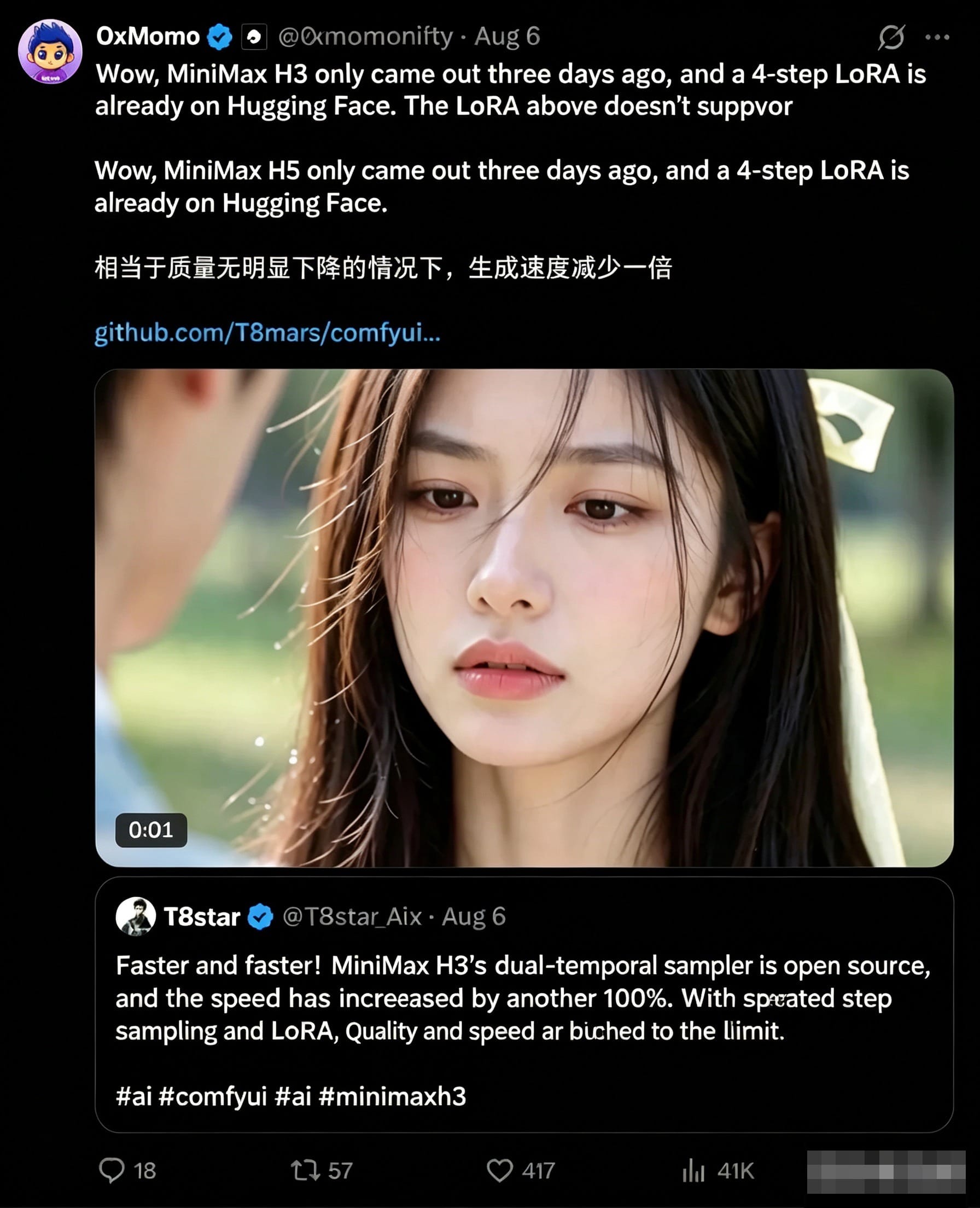
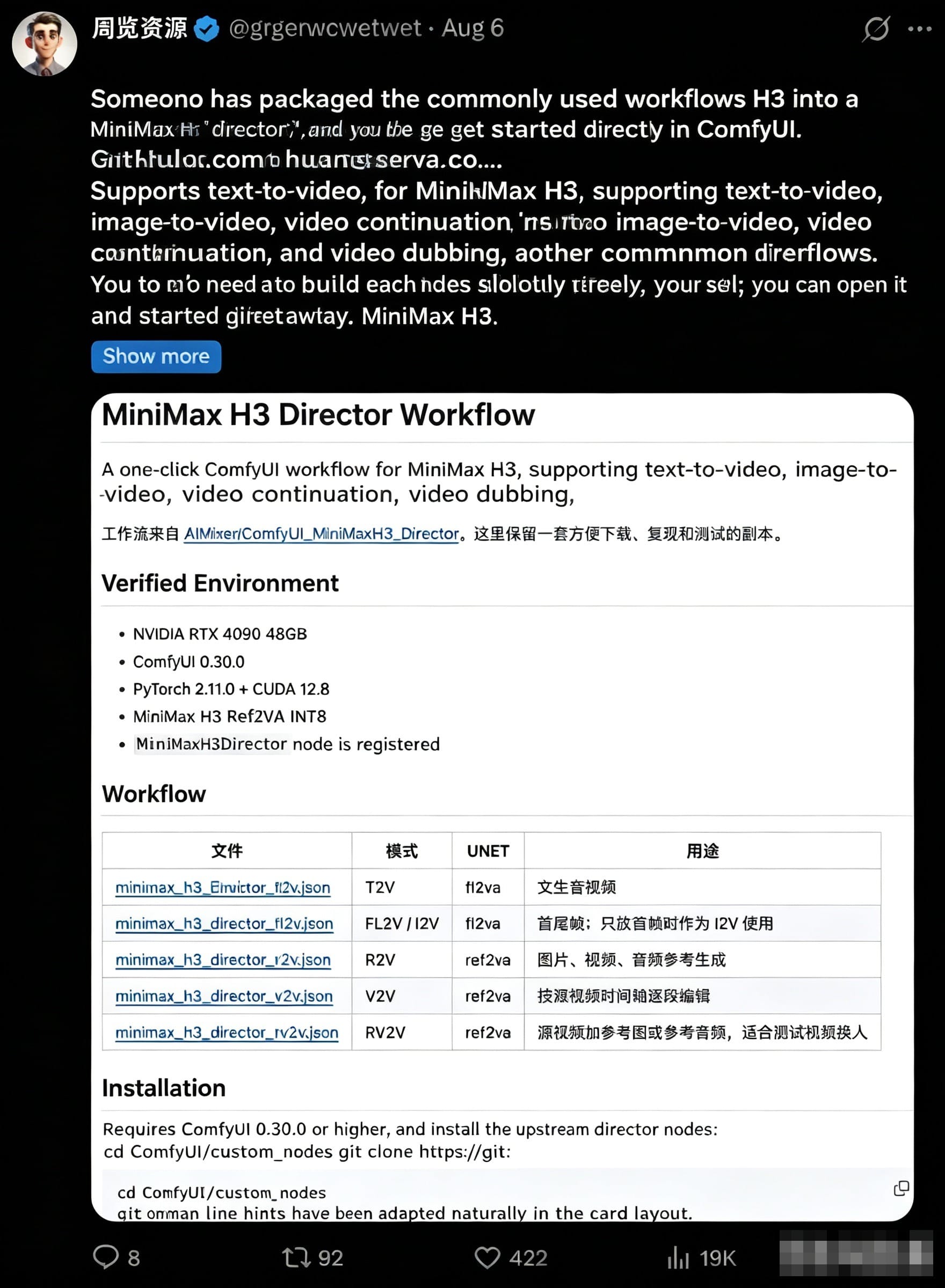
Rather than waiting for MiniMax to roll out official updates, the community immediately began heavy custom modifications: engineers built targeted quantization schemes to shrink H3’s memory footprint for consumer GPUs; others designed Turbo LoRAs to slash sampling steps from roughly 20 down to 4–8; kernel developers rewrote compute logic to expand cross-GPU compatibility. Contributors also packaged complete, ready-to-run ComfyUI pipelines covering text-to-video, image-to-video, frame-based video continuation, and reference-guided video generation. Step-by-step tutorials, custom UI nodes, optimized weight variants and configuration files spread rapidly across Hugging Face, ModelScope, GitHub and RunningHub. Without deadlines or corporate oversight, developers self-organized to build a sprawling knowledge base for H3.
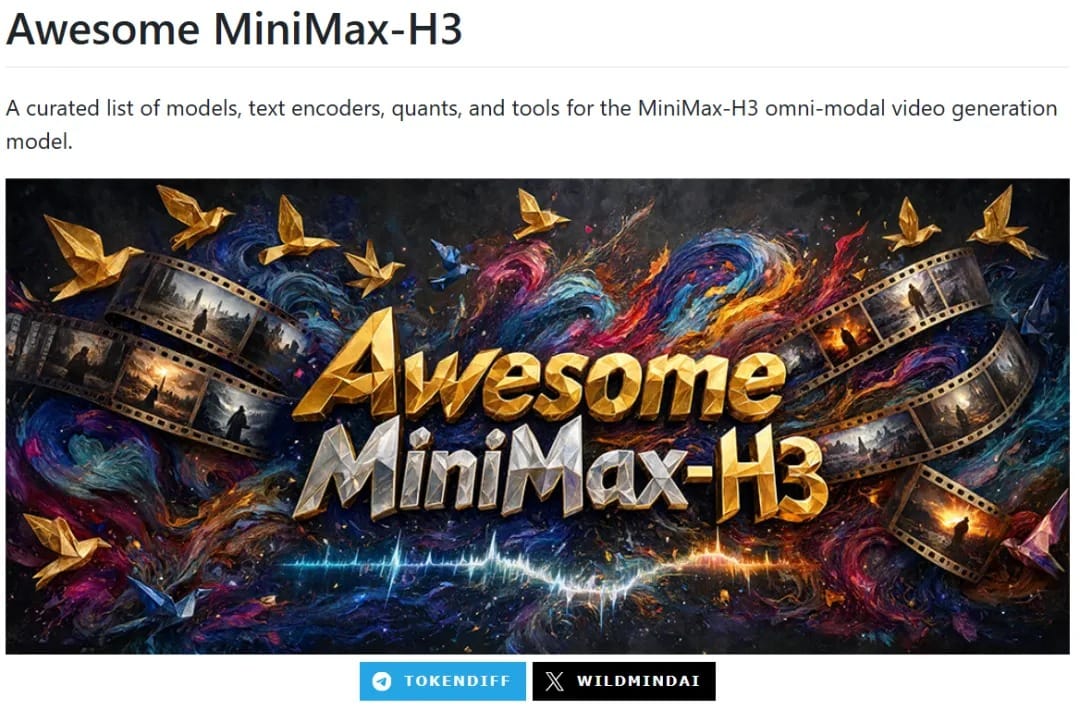
Community members compiled multi-hour deployment walkthroughs, hardware-specific weight download guides, VRAM offloading troubleshooting checklists, and speed-boosting LoRA reference sheets. Someone even launched an Awesome-H3 directory to catalog scattered model variants, VAEs, LoRAs, custom nodes and third-party tools—proof that the surrounding ecosystem had grown large enough to demand centralized curation after less than a week of open access.
It has been years since the open-source video generation space saw this level of unified, grassroots enthusiasm. To unpack what makes H3 uniquely captivating for developers, we spent the past week deep-diving into r/StableDiffusion, ComfyUI GitHub issue threads, Hugging Face model discussion boards, Bilibili tech channels and GitHub repos. We observed independent engineers dissect, compress, accelerate and reconstruct H3 to match their hardware and creative goals, and our key takeaways below double as a practical local deployment troubleshooting guide for anyone planning to run the model themselves.
2.What Separates H3: Finally a Top-Tier Open-Source Video Foundation
The open-source AI community operates on an unspoken rule: mediocre models attract almost zero engagement, and Hugging Face download metrics prove this—underperforming open weights get buried and ignored by developers. MiniMax H3 breaks this pattern entirely. As of this article’s publication, Hugging Face hosts 178 unique variants of H3 and its derivative models. The ComfyUI-optimized repackaged H3 build has surpassed 3.1 million downloads, with individual quantized versions racking up hundreds of thousands of downloads each, outperforming the official raw model files themselves.
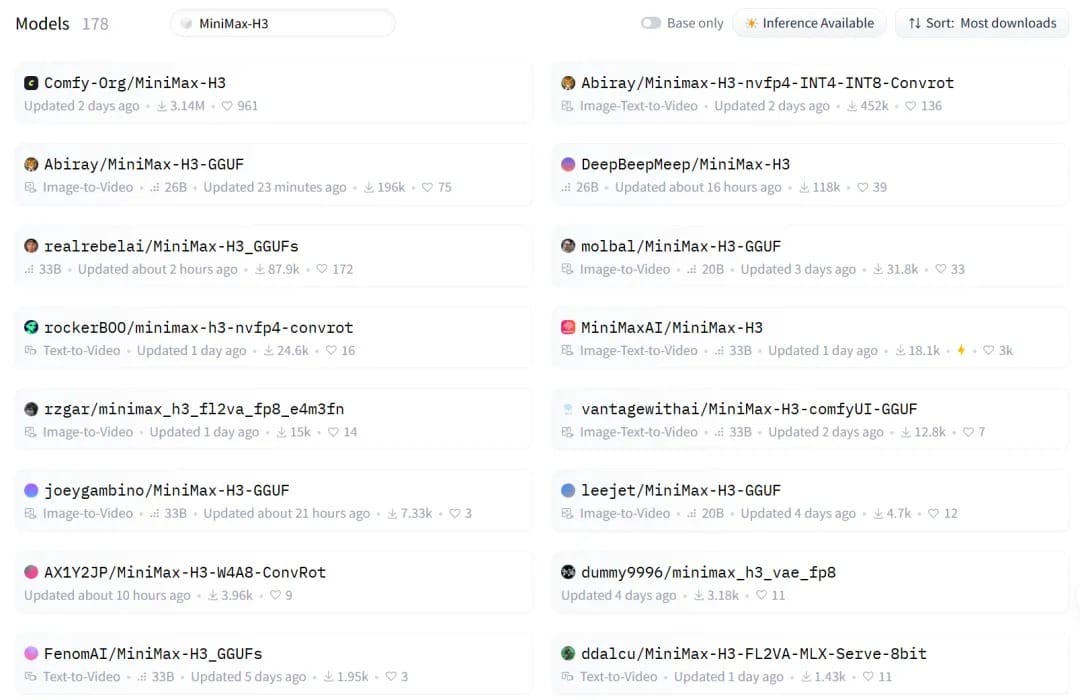
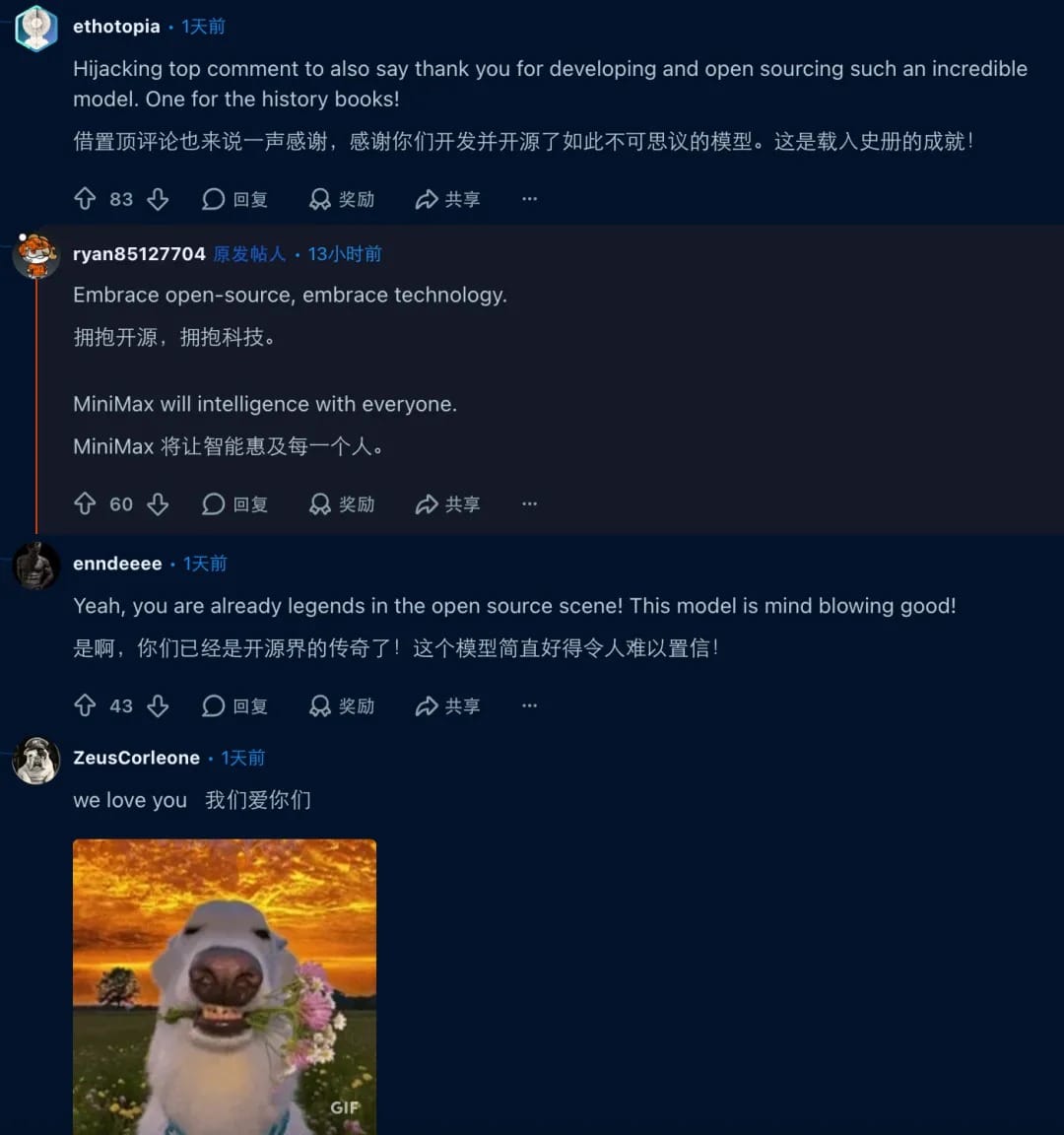
This scale of organic community growth was previously only seen with dominant open large language models such as DeepSeek. The core logic is simple: developers will not invest dozens of unpaid hours building custom variants, tooling and workflows for second-rate foundation models. This is the community voting with code and downloads. For years, open-source video generation lagged drastically behind open LLMs in ecosystem maturity; industry coverage repeatedly documented AI short-drama studios forcing staff to work overnight queuing for closed-source video APIs rather than compromising on quality with available open alternatives. H3 is rewriting this status quo, with developers globally investing hundreds of collective engineering hours to refine and expand its utility. During MiniMax’s official Reddit AMA, dozens of professional developers left dedicated comments thanking the H3 research team for releasing a truly competitive open video model.
Two core advantages explain H3’s overwhelming reception:
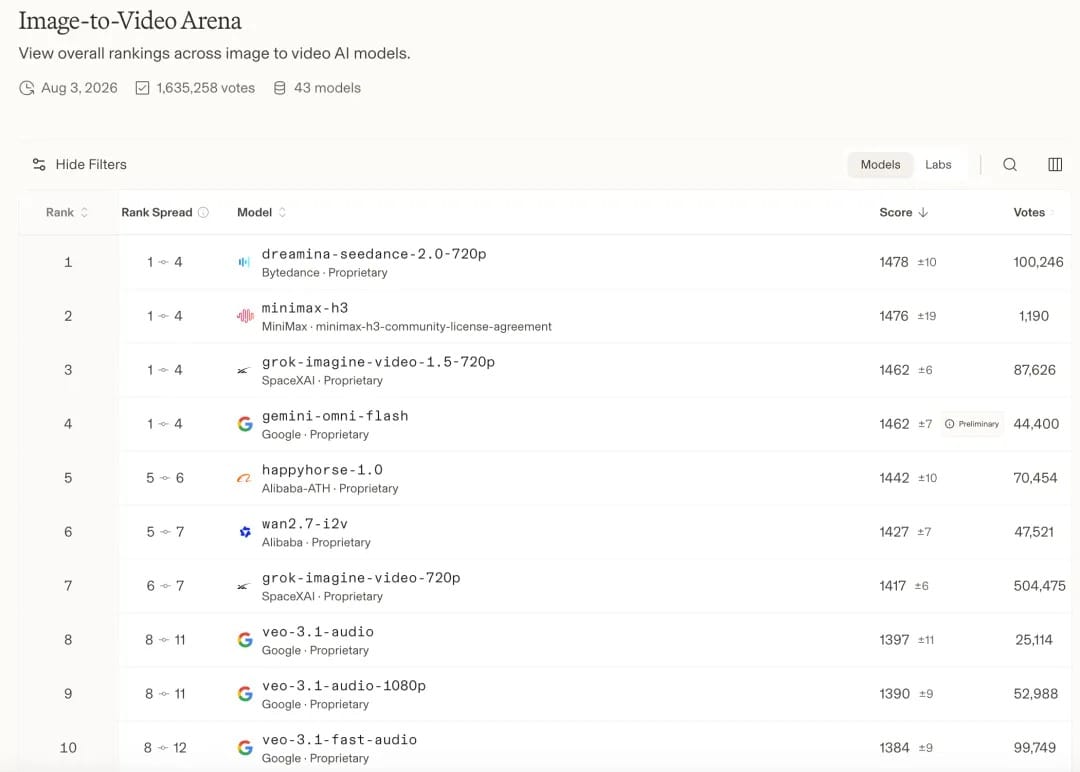
- Class-leading raw performance: Independent benchmarks from Artificial Analysis, Arena AI Image-to-Video and Design Arena consistently rank H3 as the number-one open-source video generation model, with only a marginal quality gap separating it from leading closed-source competitors. Creators no longer need to settle for subpar visual consistency, motion smoothness or audio-video sync common to prior open video models.
- Broad hardware compatibility & flexible workflows: H3 runs smoothly across an extremely wide spectrum of consumer and professional hardware, ranging from Apple Mac devices to RTX 5090, 4090, 4080 and even entry-level RTX 3060 GPUs. Regardless of available VRAM, users can find a quantized variant that works, and generated output quality far outpaces every prior open video foundation model.
MiniMax did not merely upload static weights to public platforms; it delivered a fully capable, production-grade multimodal base model, and the open-source community has taken it upon themselves to expand its functional limits. Below we break down how developers overcame H3’s core technical barriers: hardware memory constraints and slow inference speeds.
2.1 Fitting a 60B Model Onto Consumer GPUs via Community Quantization
H3 is a massive 60-billion-parameter Omni-Transformer model combining a dedicated text encoder and DiT video backbone. Its unmodified BF16 weights demand approximately 120 GB of unified memory—far beyond the 24 GB or less VRAM found on most consumer graphics cards. The community’s first critical challenge was cutting memory consumption to make local execution feasible.
ComfyUI’s core engineering team analyzed H3’s internal architecture and identified a game-changing optimization: modulation weights account for roughly 40% of total parameters, and their output values can be precomputed and cached during pure inference. Developers replaced these heavy weight layers with an equivalent lookup table, paired this tweak with int8 ConvRot quantization and custom low-peak-VRAM compute kernels, slashing total memory usage by 66%—from 123.6 GB in full precision down to just 42.5 GB for the smallest streamlined variant. Combined with dynamic layer offloading, this optimization makes H3 operable even on an RTX 3060 entry-level GPU.
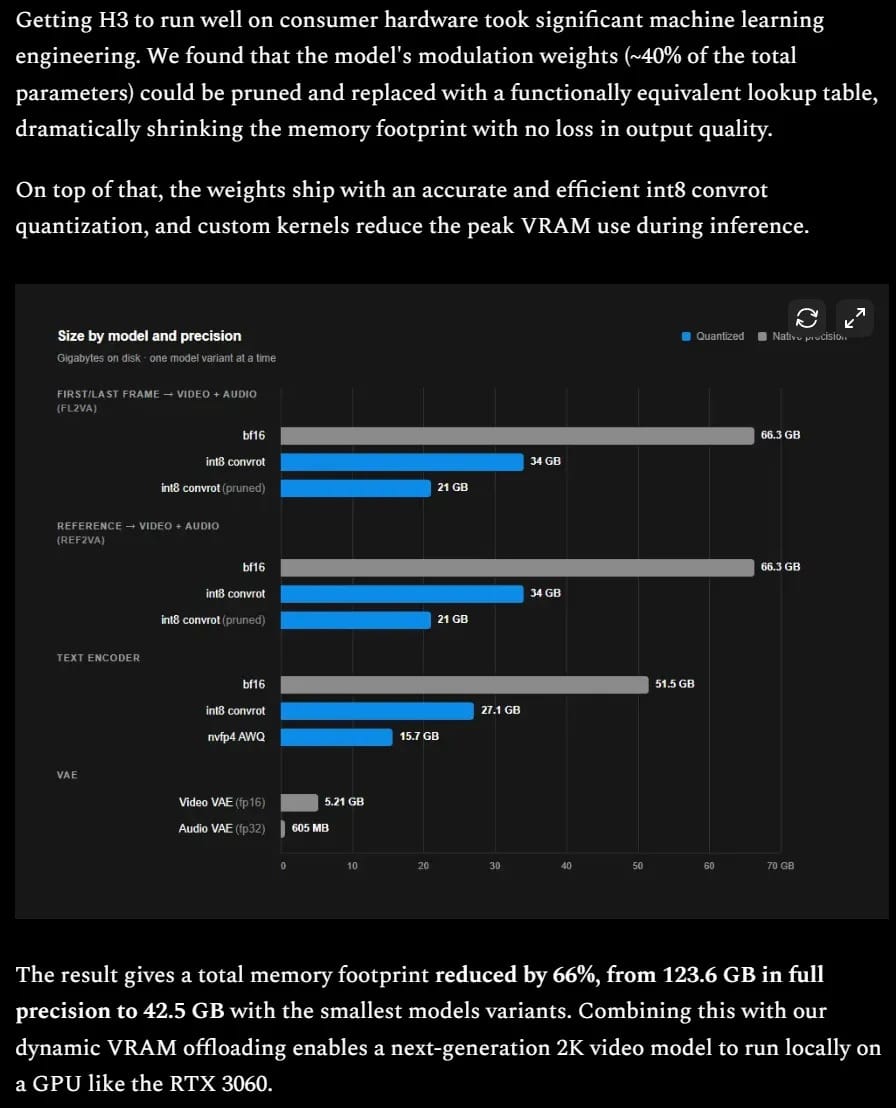
Crucially, MiniMax’s official pre-release blog post already documented this AdaLN modulation caching logic for inference. The company intentionally published both full training-ready weights and documentation of inference-only optimization paths, a remarkably developer-friendly choice that eliminated guesswork for third-party engineers building lightweight distributions.The community rapidly rolled out quantized builds tailored for every VRAM tier, spanning GGUF formats from Q2_K to Q5_K_M, NVFP4, mixed INT4/INT8, OrbitQuant W4A4 and experimental W4A8 quantization. ModelScope’s DiffSynth-Studio team even released an NF4 quantized version that lowers the minimum hardware requirement to just 8 GB VRAM, while Mac developers ported full MLX compatibility for Apple Silicon chips. This single week of optimization resembled a Cambrian explosion of specialized H3 variants.
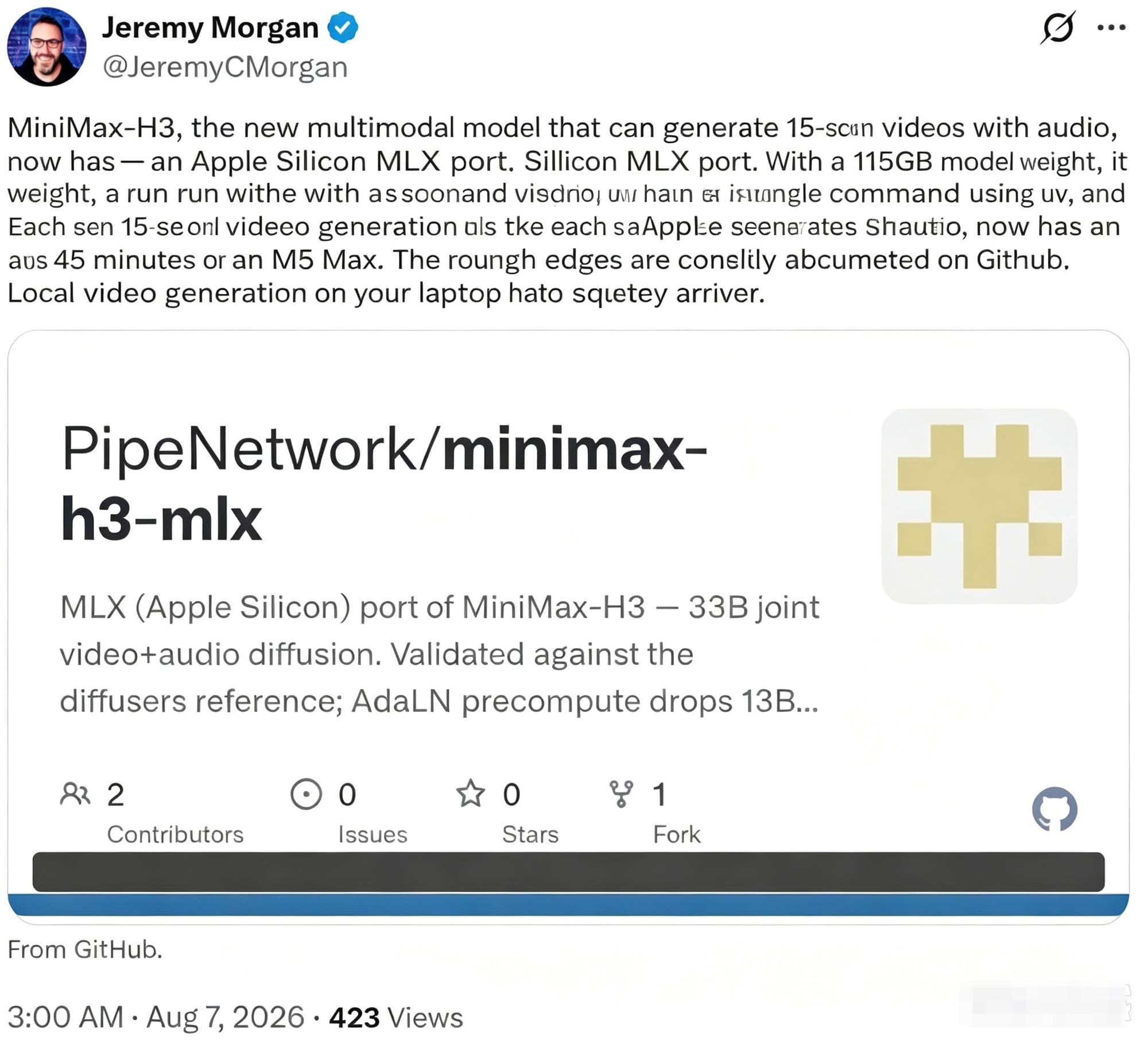
Engineers also pushed H3 through extreme stress testing across diverse hardware:
- One contributor released a custom ComfyUI patch optimized for AMD RDNA4 R9700 AI Pro, complete with three end-to-end workflows and tuned launch arguments that generate 5-second clips in roughly 45 seconds with Turbo LoRA acceleration.
- A four-GPU RTX 3090 deployment team cut generation time for identical footage from 11 minutes 21 seconds down to 3 minutes 45 seconds, without any hardware upgrades—improvements stemmed from an AI agent-rewritten CUDA attention kernel paired with community-shared step-reduction LoRAs hosted on Hugging Face.
- One developer successfully booted H3 on a four-year-old budget gaming laptop with only 6 GB VRAM by dropping resolution to a compressed 0.2-megapixel frame size; the tradeoff: a single 15-second clip required 40 minutes of continuous rendering.
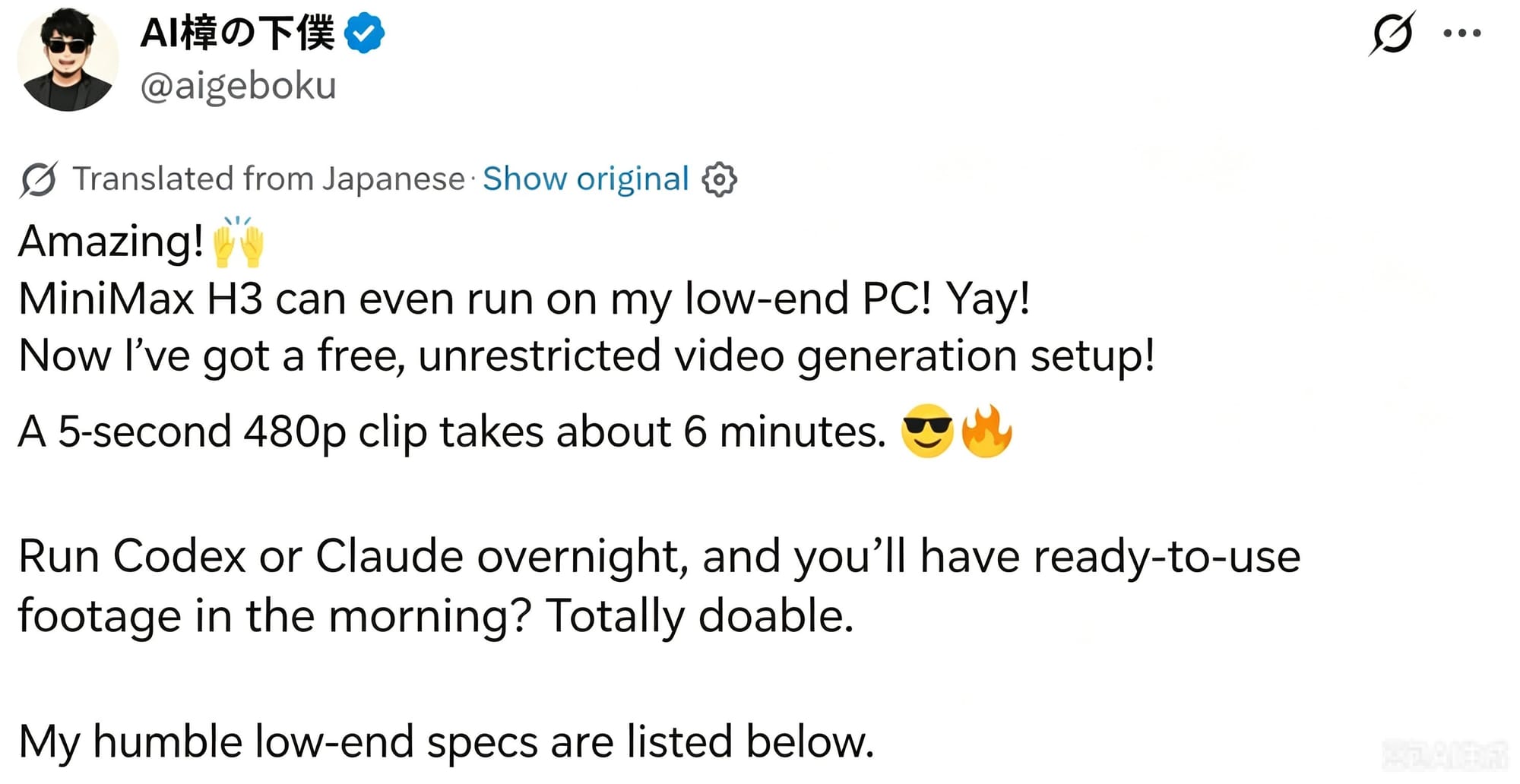
Based on real-world benchmark data from all community quant builds, here is a clear hardware tier guideline for local deployment:
- 24 GB VRAM: The ideal comfortable baseline; INT8 quantized weights + layer-wise offloading deliver stable, fast full-quality generation.
- 16 GB VRAM: Stick to INT4 or NVFP4 quantization to avoid constant weight shuffling bottlenecks.
- 8 GB VRAM: NF4 quantization works, but users face noticeable drops in visual fidelity and rendering speed—best reserved for workflow validation rather than final high-quality exports.
A widely overlooked performance note surfaced during MiniMax’s Reddit AMA and ComfyUI Live stream: slowdowns are inevitable when the full model cannot fit entirely inside VRAM. ComfyUI automatically transfers weight blocks between GPU VRAM and system RAM mid-render, so real-world generation speeds vary drastically based on system memory throughput and PCIe bandwidth—identical GPUs will deliver inconsistent performance across different host PC builds. VRAM offloading sliders act as a configurable dial to balance rendering speed and visual output quality.
2.2 Cutting Render Time: Community-Built Turbo LoRAs for Fast Inference
Once developers solved hardware compatibility, the next major pain point became painfully slow inference. Generating 10–15 second video clips could take ten-plus minutes of waiting, a crippling bottleneck for creators iterating constantly on prompts, framing and scene composition.On August 5, only one day after weight open-sourcing, developer larryvrh published the first speed-optimized Turbo LoRA for H3. This lightweight auxiliary model cut default sampling steps from ~20 down to just 4, delivering approximately 5× faster end-to-end generation for synchronized stereo audio and video outputs; the project received a major feature update earlier this week.
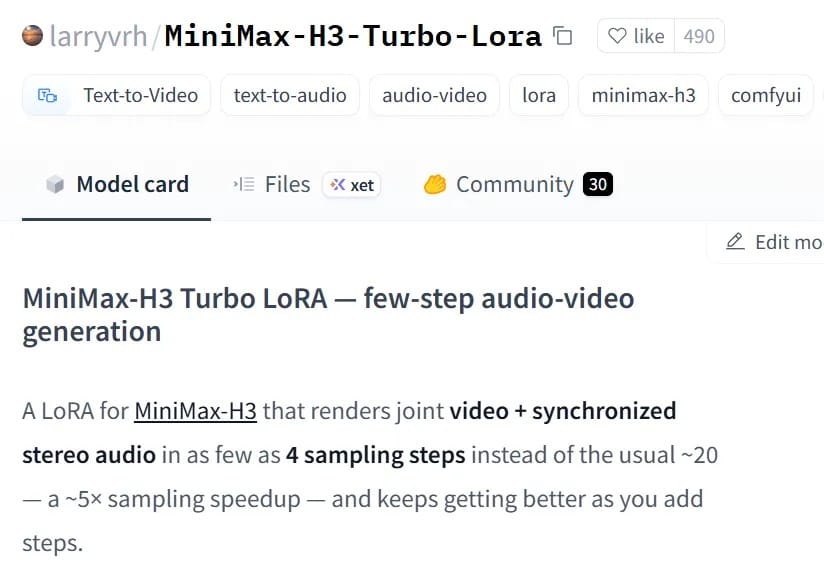
Its creator shared actionable production guidance: 4-step sampling delivers quick rough previews but produces soft, blurry visuals, while 6–8 sampling steps strike the current ideal balance between rendering speed and sharp, coherent motion fidelity.Shortly after this release, ModelTC and lightx2v rolled out a formal 4-step distillation scheme named MiniMax-H3-Turbo. Within China’s generative AI community, popular Bilibili creator T8star-Aix built ComfyUI-compatible acceleration LoRAs and open-sourced a dual-clock sampling engine that supports flexible separated step tuning for speed and quality.MiniMax’s official X account publicly praised this community progress, commenting four days post-open-source that the developer ecosystem had delivered research-grade acceleration tools typically developed in internal lab environments, adding “This is exactly why we chose to open-source H3.”That said, aggressive step reduction carries unavoidable visual tradeoffs, which MiniMax’s research team clarified during the Reddit AMA. The default released H3 checkpoint already incorporates built-in CFG distillation, and its final training phase grants inherent low-step inference capacity—but the weights were not purpose-built for extreme 4-step minimal sampling workflows. The MiniMax team is actively researching dedicated step-distillation variants to cut inference overhead without sacrificing visual consistency, and is evaluating potential 4-NFE and 8-NFE specialized builds, though no official release timeline has been confirmed.A simple actionable workflow rule emerged from all community testing: use 4-step sampling exclusively for fast concept previews and rough composition blocking, then revert to 6–8 steps for polished final renders. If users observe distorted character geometry or broken audio-video sync, overly minimal sampling steps are the first variable to adjust, rather than rewriting prompt text.
The Community’s Full Spectrum of Creative & Production Workflows
Beyond hardware optimization and speed tuning, the most fascinating layer of H3’s open-source movement lies in its wildly diverse real-world applications. We have covered viral artistic experiments—Chinese mythic landscape recreations, game concept reels, reimagined Hollywood movie scenes, and those unorthodox “hack workflows” repurposing the video model for standalone image or audio generation. Digging deeper into community forums reveals far more structured, production-ready techniques creators rely on for stable, repeatable output.
3.1 Standardized Prompting & Shot Design Best Practices
One prompt framework exploded across Hugging Face discussion boards: timestamp-based storyboarding.
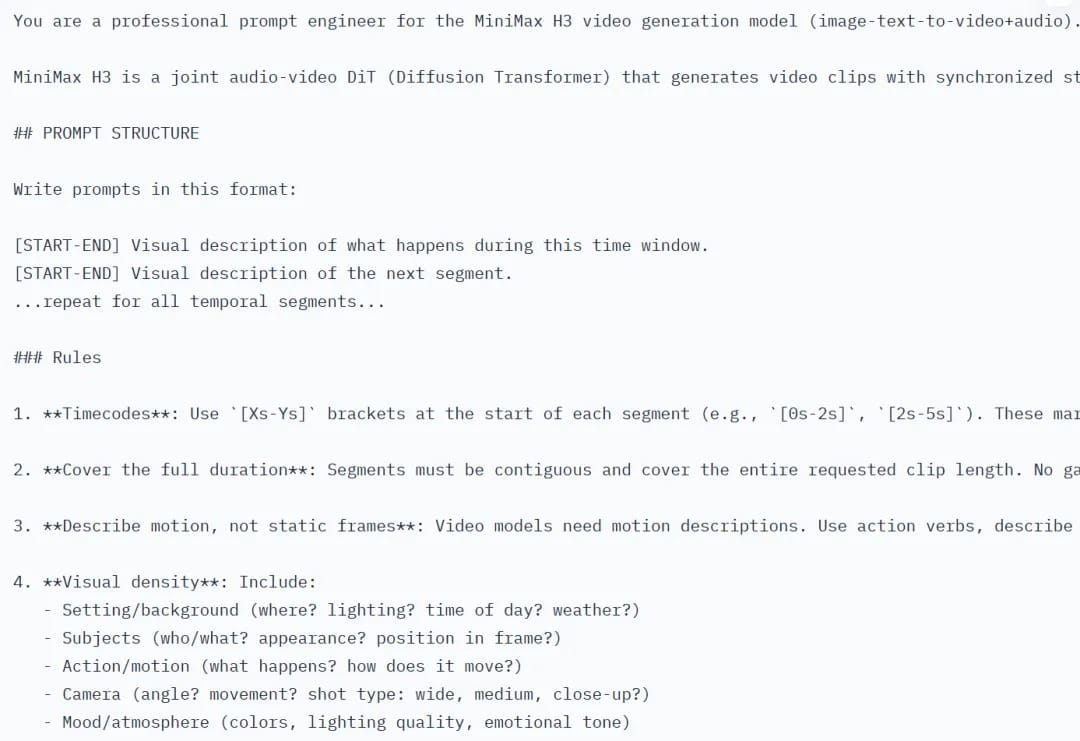
Creators split full video scripts into time-bound shot segments formatted as [0s‑2s], [2s‑5s], with each block including dedicated style rules, cinematography direction, audio cues, on-screen text lines and negative prompt filters. This modular template has been integrated into dozens of third-party H3 deployment guides.MiniMax’s research engineers shared two high-impact production tips during their ComfyUI live broadcast:
- Improving lip-sync accuracy for dialogue-heavy scenes: Many users report misalignment between reference audio tracks and character mouth movements. The official recommended fix: feed your voice audio as a reference condition, wrap all spoken character lines in quotation marks within your prompt, and attach each line directly to its corresponding timestamped shot description. This drastically boosts consistent, natural lip movement synchronized to speech.
- Building multi-shot product advertisement reels: Define total video duration and shot count upfront (e.g., a 10-second spot split across 5 individual 2-second shots). Use an LLM prompt enhancer to generate refined preview prompts, then feed multiple reference images to lock consistent product styling. Pre-built base ComfyUI templates for this exact workflow are already available for customizable shot sequencing and prompt adjustment.
Building on these official recommendations, community creators validated two advanced pipelines: users can input a single static portrait plus reference voice audio to generate perfectly lip-synced talking head clips; others produce five+ distinct camera shots within a single 15-second generation window while retaining consistent character designs and environmental backgrounds—work that previously required manually splicing separate rendered clips together.Those seemingly “hacky” cross-modal workflows are not random accidents; they align with intentional design baked into H3’s training architecture:
- Image-editing trick via ultra-short video generation: Users generate 1–2 frame tiny video snippets and extract clean individual frames for photo retouching. During the AMA, MiniMax researchers revealed internal training observations: their team built a test sub-model tasked solely with predicting an end frame from a starting frame and text caption, and it delivered powerful zero-shot image-editing benchmark results with no specialized fine-tuning. H3’s core in-context multimodal learning naturally generalizes to image manipulation tasks, and the community’s workaround simply unlocked this native capability.
- Pure audio generation at minimal resolution (32×32 frames): H3 processes video and audio signals through joint diffusion denoising in one unified pass, eliminating post-production audio-video alignment work entirely. When visual frame resolution is compressed to negligible compute weight, the model’s computational resources prioritize audio channel generation, producing clean, coherent voice and sound effect tracks.
3.2 Industry-Grade Selective Video Editing Capabilities
H3 stands out among open video models for its precise editing functionality, currently ranked number one on Artificial Analysis’s dedicated video-editing benchmark leaderboard.
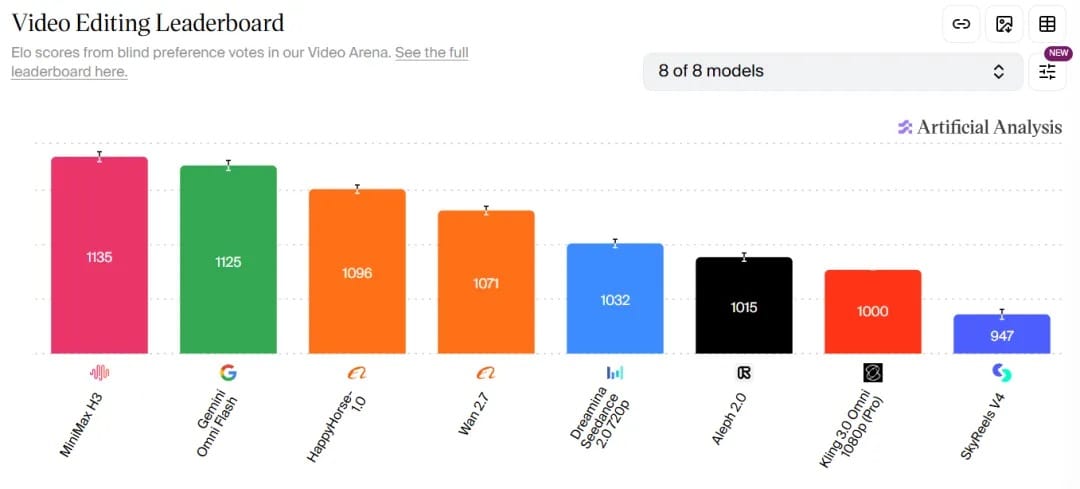
During the Reddit AMA, a professional film editor shared two hands-on real-world test cases demonstrating its practical production value:
- He took 10 seconds of raw handheld backyard B-roll, paired it with a reference image of a velociraptor, and instructed H3 to composite the creature walking and hunting naturally within the existing scene. The model preserved original camera motion, background texture and lighting, only modifying the targeted creature layer without corrupting unrelated background elements.
- He uploaded green-screen dance talent footage alongside a static neon city street background reference, requesting full background replacement and relighting matching the new environment. While minor visual imperfections remained, the composite lighting and character integration functioned coherently for draft production work.
The editor’s core takeaway resonates across creative industries: selective, mask-free editing that only modifies targeted subjects while preserving untouched scene detail delivers tangible workflow value for commercial video production teams.
3.3 Extending H3’s Native 15-Second Window for Long-Form Video
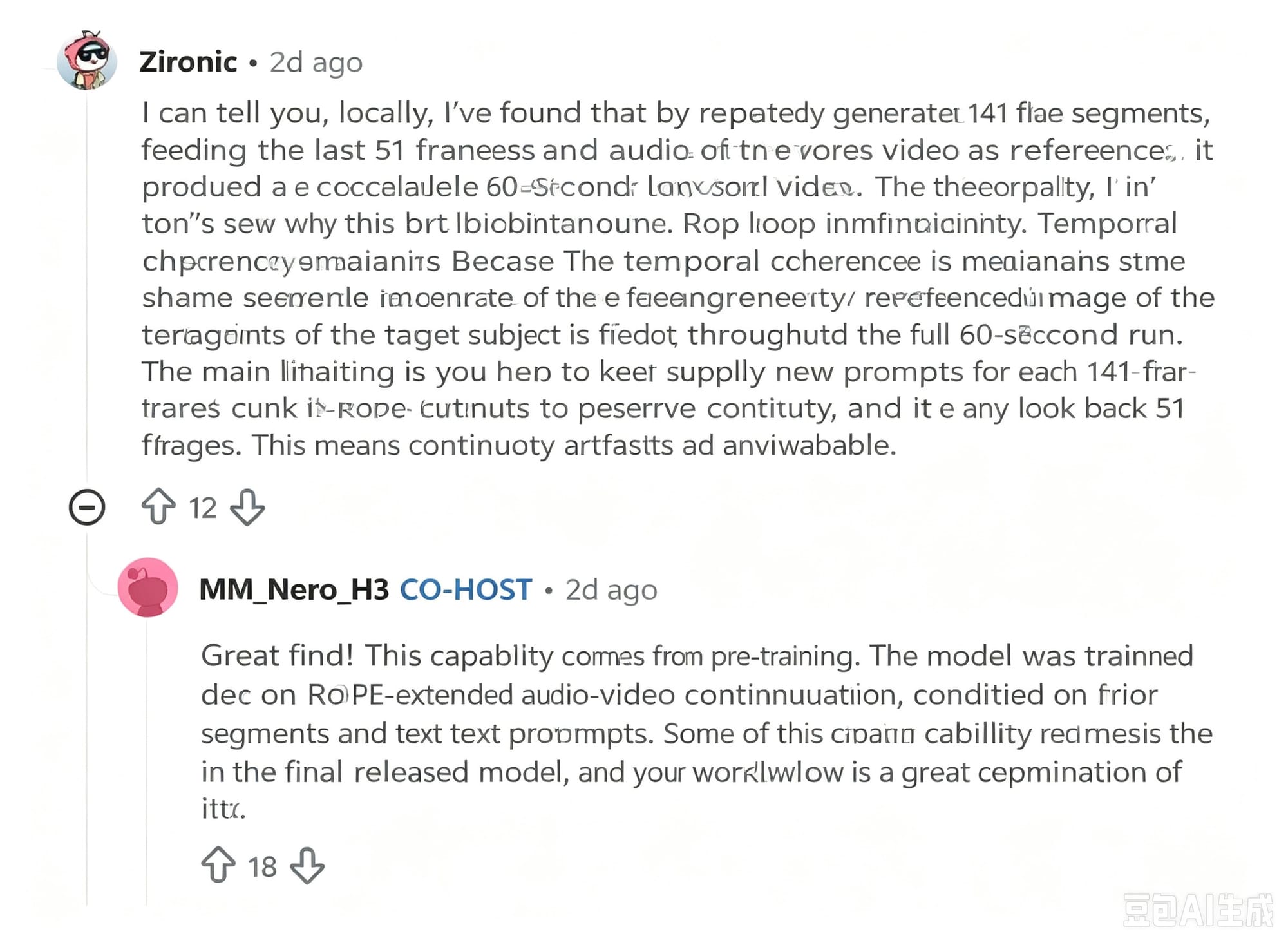
H3’s native single-pass generation limit caps out at 15 seconds of footage, but Reddit user Zironic pioneered a repeatable recursive workflow to extend clips to 60 seconds or longer.
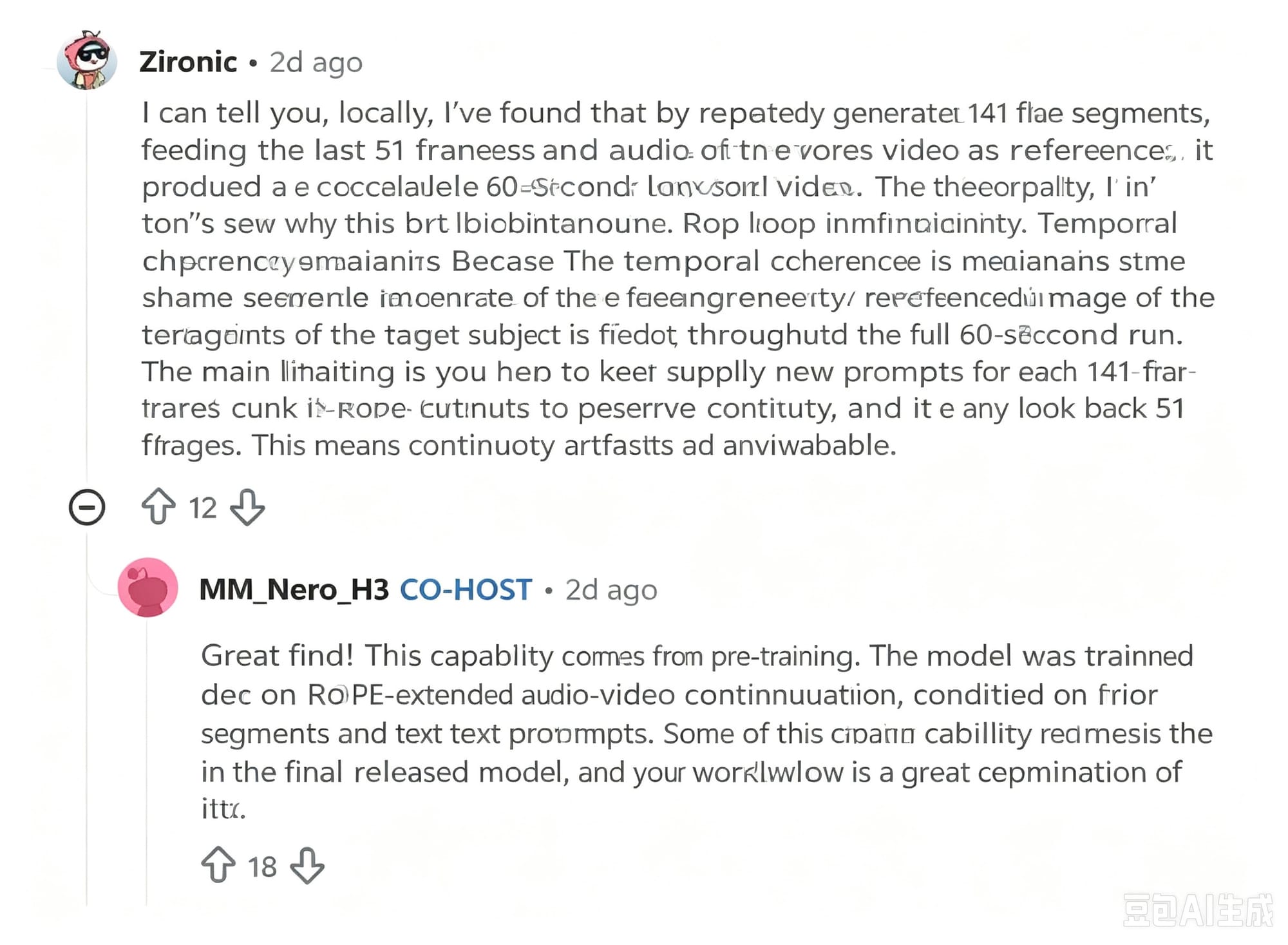
The method works as follows: generate 141-frame video-audio chunks iteratively, feed the final 51 frames of the previous segment as reference input for the next render pass, and continuously attach a fixed character reference image to retain subject consistency across all shots.MiniMax later officially acknowledged this technique, confirming it leverages built-in pre-trained audio-video continuation logic within the Ref2VA conditioning pathway. The team also clarified critical limitations: H3 was never pre-trained for extended recursive multi-segment long-form trajectories, and truly seamless native long-video generation would require additional training with sparse attention architectures optimized for extended context windows.Other widely adopted community workflows include automatic lip-sync portrait generation from audio references and consistent multi-scene short film creation with locked character and spatial aesthetics.
H3 Moves From Experimental Demos to Integrated Production Pipelines
Community development has rapidly evolved from standalone test clips to fully packaged, end-user-friendly production tools. Projects like ComfyUI-MiniMaxH3-Easy bundle text-to-video, image-to-video and reference-guided generation into a unified one-click workflow. MiniMaxH3 Director—a popular open-source ComfyUI plugin we covered in earlier technical breakdowns—implements an intuitive “director console” UI, consolidating text-to-video, frame-based continuation, subject replacement and multi-shot timeline editing on a single streamlined panel. RunningHub maintains an independent third-party ComfyUI plugin suite embedding H3’s full runtime directly within ComfyUI’s process, covering T2VA, FL2VA and Ref2VA generation pipelines. Paired with INT8 quantized weights and layer-wise VRAM offloading, this full stack runs smoothly on any single 24 GB consumer GPU.These abstraction layers eliminate mandatory deep technical knowledge of model architecture; creators only need to define their creative goals, rather than tweak raw diffusion parameters or handle complex tensor wiring manually.Developers are also seamlessly slotting H3 into pre-existing professional creative stacks: content creators chain it alongside Krea, ElevenLabs and Suno to build complete end-to-end multimedia production pipelines. One agent-powered automated workflow combines MiniMax voice cloning and HeyGen digital human tools with H3: the system first validates input asset resolution, clarity and format, generates low-weight 720p 15-second preview clips to inspect facial animation and lip-sync accuracy, and only proceeds to render full 1080p final footage once the creator approves the preview output.Reflecting on all community innovation over this opening week, one unifying theme emerges: H3 merges text, image, video and audio within a single shared multimodal context. Pushing one modality to its computational limit naturally prioritizes another. Minimize visual resolution, and it operates as an audio generator; shorten render duration to a handful of frames, and it acts as a high-performance image editor; feed prior clip endings as reference conditioning, and it becomes a seamless video continuation engine. The community is not inventing entirely new external features for H3—they are uncovering the full, untapped potential locked within its foundational multimodal design, which far exceeds the narrow use cases outlined in its initial release documentation.This “one base model, countless customizable integrations” architecture creates cascading industry ripple effects that stretch far beyond GitHub and Hugging Face’s developer bubble. As optimized quantization builds, pre-built workflows and user-friendly wrapper tools proliferate atop identical core weights, value is distributed across every layer of the tech ecosystem.
Cross-Industry Ripple Effects of H3’s Viral Open-Source Launch
H3’s explosive breakout success captured attention far beyond generative AI developer circles, resonating across global media, hardware manufacturing, cloud computing and capital markets alike.International mainstream media framed H3 as a landmark milestone in Chinese tech firms’ push toward transparent, accessible open-source AI development. Reuters highlighted two game-changing commercial advantages: H3’s 2K video generation cost lands at less than one-third the price of leading closed-source competitors, and its core architecture was engineered with native compatibility for a wide range of domestic Chinese silicon chips alongside global hardware brands. Domestic pricing metrics align with this reporting: approximately ¥0.5 per second for 768p resolution footage, and ¥0.8 per second for full 2K output.
Hardware and cloud industry responses were immediate and concrete. Over 100 domestic and international tech partners completed day-zero full integration upon H3’s release. Fal rolled out three dedicated exclusive API endpoints as MiniMax’s official commercial partner; RunningHub embedded H3 functionality across its entire product lineup; vLLM-Omni, SGLang and Tencent Cloud added dedicated optimized inference support. Nine major chip manufacturers—including Huawei Ascend, Moore Threads, Muxi, Kunlun, AMD and Intel—finished full model adaption work on the exact day weights went public.Capital markets also registered strong positive sentiment toward MiniMax’s open-source strategy. Jefferies restated its buy rating with a HK$1118 share price target, while Citi emphasized H3’s commercial-grade content generation capacity and maintained its own buy recommendation for the company.Collectively, these cross-industry reactions illustrate the transformative ripple power of open-sourcing a competitive foundation model. Capabilities previously locked behind paywalled closed APIs become public, interoperable building blocks accessible to every developer and business. Chip vendors tune their silicon performance specifically for H3’s compute patterns; inference frameworks optimize throughput for its diffusion logic; cloud providers launch specialized compute packages targeting H3 workloads; workflow developers ship simplified consumer-facing wrappers; independent creators produce marketable finished video content. Every layer of the ecosystem captures independent economic value—a dynamic no closed-source API, even with aggressively low pricing, can replicate.
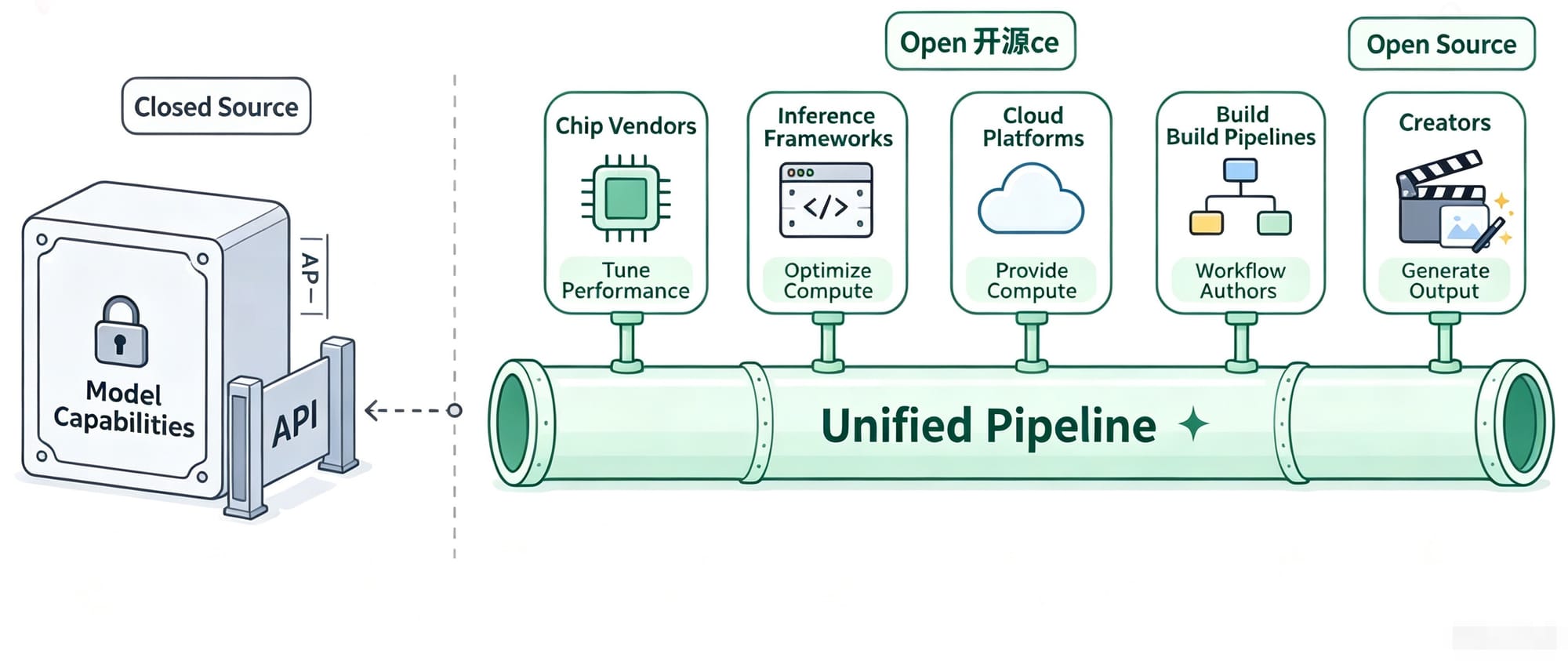
For years, industry competition revolved purely around comparing isolated raw model performance benchmarks. Today, the competitive landscape has shifted dramatically to prioritize ecosystem execution: how efficiently a model’s weights run on affordable consumer hardware, how seamlessly its tooling integrates into existing creative pipelines, and whether the global developer community is motivated to invest unpaid time building atop your foundation model.
Final Thought
MiniMax H3’s opening‑week open‑source success is more than a viral model release. It mirrors DeepSeek’s playbook: releasing competitive foundation weights unlocks decentralized innovation, drawing hobbyists, engineers and industry players to build on top of it.Closed‑source video tools keep advanced capabilities behind API paywalls.By open‑sourcing a production‑ready multimodal model, MiniMax hands powerful video‑generation infrastructure to the broader community. This grassroots ecosystem momentum sets a new benchmark for open‑source video AI, foreshadowing where the space will head next.